2025
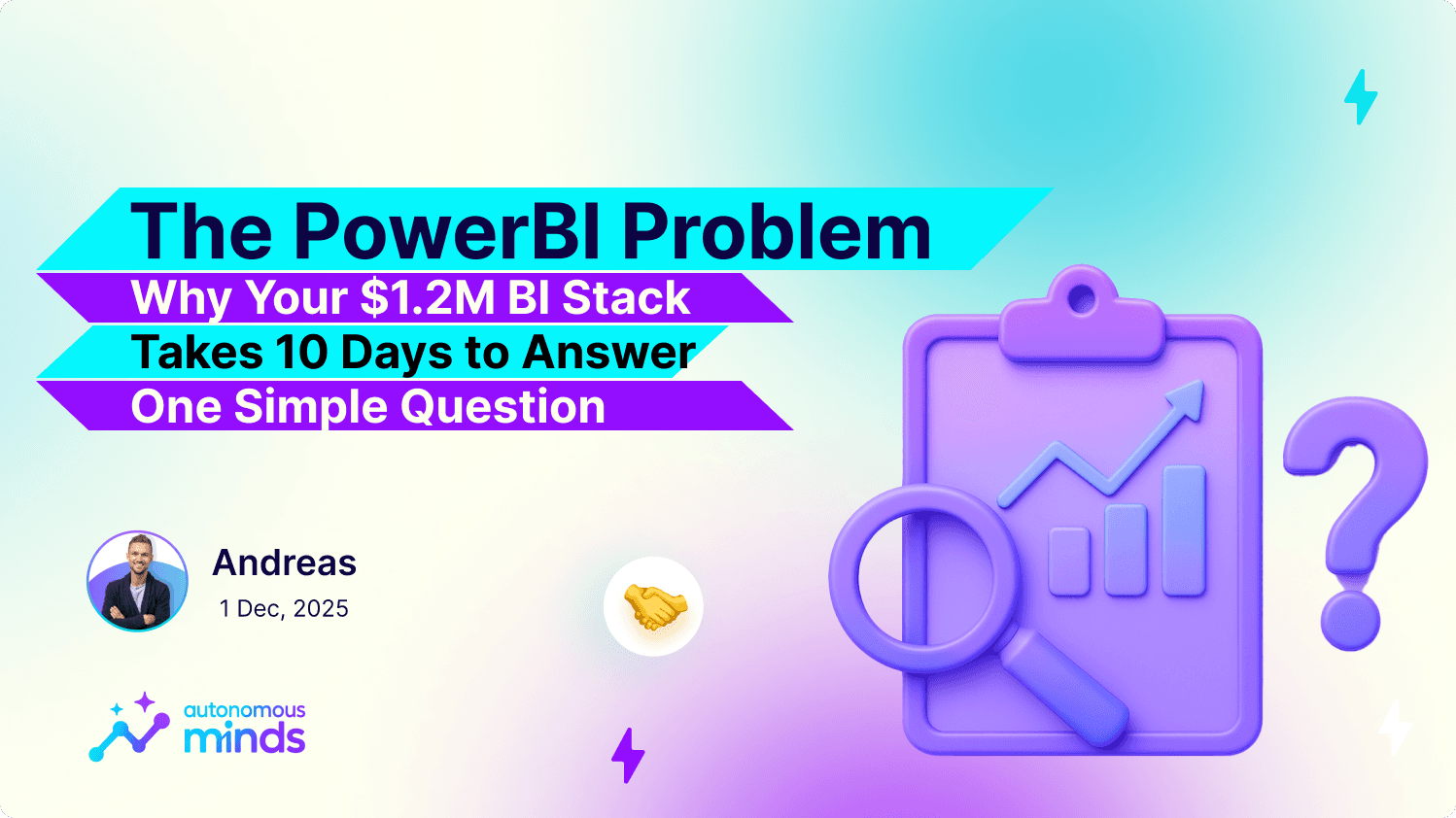
The PowerBI Problem: Why Your $1.2M BI Stack Takes 10 Days to Answer One Simple Question
PowerBI isn't failing because it's clunky or slow. It's failing because it can't give you answers. When a simple question like "Which customers are at risk of churning?" or “How did last week’s promotion campaign perform?” takes 10 days and five meetings to resolve, your BI stack isn't a decision tool, it's a bottleneck. Generative BI collapses that loop from days to minutes.

Andreas Koeberl
Co-Founder
The PowerBI Promise vs. The PowerBI Reality
Remember the pitch? "Self-service BI! Empower everyone to make data-driven decisions! Democratize your data!"
Here's what actually happened:
BI tickets still take a week to 10 days for anything that isn't already pre-built
Non-technical users are locked out because drag-and-drop doesn't mean accessible
Dashboards show what happened, never why or what to do next
Enormous technical pre-requisites regarding infrastructure, data modeling and human (data engineering) effort to keep it alive
Result: An expensive dashboarding platform that creates more meetings, not better, quicker decisions.
Companies spend roughly $650–$1,200 per FTE per year on BI software and headcount. Add infrastructure, and you're easily crossing seven figures annually. Yet most decisions still aren't backed by data, because by the time you get an answer, the window to act has closed.
The problem isn't that PowerBI is broken. It's that dashboards are the wrong paradigm for how modern businesses need to operate.
Why Dashboards Can't Answer Business Questions
Let's take a real example: "Which customers are at risk of churning?"
The PowerBI World:
Open a dashboard (if one exists for churn risk)
Stare at charts trying to interpret signals
Schedule a meeting with Customer Success and Customer Support
Loop in Sales to cross-reference pipeline data
Pull in BI to explain what you're actually looking at
Wait for Finance to validate ARR impact
10 days later, you have an answer
By then, three at-risk customers have already churned
The Fundamental Problem:
Dashboards were built for reporting, not answering questions. They require you to:
Know what you're looking for before you start
Interpret correlations without understanding causality
Manually piece together context from multiple tools
Schedule meetings to turn charts into narratives
Figure out next steps entirely on your own
PowerBI ends at visualization. The moment you need to understand why something happened or what to do about it, you're back to spreadsheets, Slack threads, and meeting invites.
And this doesn't just frustrate business stakeholders, it wastes your talented analytics teams on tedious, repetitive work that should be automated.
The Three Things PowerBI Can't Do (That Matter Most)
1. PowerBI Can't Explain "Why"
What PowerBI shows you: Revenue down 7% in EMEA.
What you actually need: Device mix shifted to mobile web (lower conversion); UK promotional pricing ended on the 15th; two enterprise deals worth £340K slipped to next quarter due to procurement delays.
Without causal explanations, every chart becomes a guessing game. You're paying for data visualization, but you still need humans to connect the dots, validate hypotheses, and build the narrative. That's why the same question triggers five meetings, no one trusts the dashboard alone.
Generative BI surfaces drivers with evidence: temporal alignment (what changed when), feature importance (which factors mattered most), and business context (campaigns, outages, pricing changes). It distinguishes "looks related" from "likely caused."
2. PowerBI Can't Handle Ad-Hoc Questions
Every new question requires:
A new dashboard (if you're lucky)
A BI ticket (if you're realistic)
A 10-day wait (if you're being honest)
The painful loop:
Raise a BI ticket
Wait a week to 10 days (unless you're C-level)
Hop on a few meetings to discuss what you actually wanted and what PowerBI can’t show or process (e.g. qualitative or conversational data)
...and the moment is gone, no action will ever be triggered
For non-technical users, PowerBI is basically useless for anything ad-hoc. You end up back in spreadsheets, copying data from three tools, trying to answer the question yourself.
Generative BI approach: Ask in plain English ("Why did churn spike in July?"), get a fresh analysis in 2–3 minutes, with context pulled from your warehouse, CRM, support tickets, and Slack. No pre-modeling required. No BI ticket.
3. PowerBI Can't Close the Loop
Here's the part that really hurts: PowerBI ends at a chart.
You get your answer (eventually), and then what?
Manually flag at-risk accounts in CRM
Draft a Slack message summarizing findings
Schedule a follow-up meeting to assign owners
Copy/paste charts into a slide deck for leadership
Create a spreadsheet to track next steps
Every insight requires 4–6 manual steps to turn into an outcome. The execution latency gap, the time between seeing a signal and doing something about it, is where your BI investment goes to die.
Generative BI closes the loop: Once you have the answer, the system can update CRM, create owner tasks, post Slack summaries, generate partner-ready PDFs, and trigger follow-ups, all with approvals, RBAC, and audit trails. What → Why → Done, in minutes.
Generative BI: From Dashboards to Decisions in 2–3 Minutes
Let's replay the churn example:
You ask: "Which customers are at risk of churning?"
Generative BI (e.g., Milo) responds in 2–3 minutes:
Identifies cohorts with usage dips, support ticket surges, failed payments, or contract renewals approaching
Explains the drivers with evidence: "Pro plan customers in EU with <2 logins/week in the past 30 days and open 'billing' tickets"
Then triggers actions:
Flags accounts in CRM with "Churn Risk - Low Engagement" tag
Creates owner tasks for CSMs with context and recommended outreach
Posts a Slack summary to #customer-success with cohort size and ARR at risk
Generates a one-page PDF for leadership
(Plus a dashboard, if you really want one.)
The difference: You don't just get an answer. You get an explanation, evidence, and the next three steps already in motion, with governance, approvals, and receipts.
What "Dead" Actually Means
PowerBI isn't going to disappear tomorrow. It still has a role:
Static reporting: Financial close, regulatory packs, board decks
Curated KPIs: Metrics that don't change and don't need explanation
Historical analysis: When you have time to explore, not urgency to act
But for operational decisions, the ~1,320 micro-decisions per knowledge worker per year (approvals, escalations, triage, follow-ups), dashboards are the wrong tool.
The $105 billion decision market doesn't belong to platforms that generate meetings. It belongs to platforms that generate outcomes.
BI isn't dying as a category. It's stopping being a standalone function and becoming embedded in how teams operate: natural language questions, causal explanations, and governed actions in one motion.
The Bottom Line
You can keep paying $650–$1,200 per FTE per year (plus infrastructure) for dashboards that:
Take 10 days to answer ad-hoc questions
Require five meetings to explain what you're looking at
End at visualization, forcing you to manually trigger every next step
Or you can adopt decision infrastructure that answers questions, explains drivers, and closes the loop, in 2–3 minutes, with approvals and audit.
PowerBI isn't broken. It's optimized for the wrong job.
The future belongs to platforms that don't just show you what happened. They explain why it happened, and then handle what comes next.
More insights to explore
Discover additional case studies, tips, and strategies to help your business grow and innovate faster.