2026
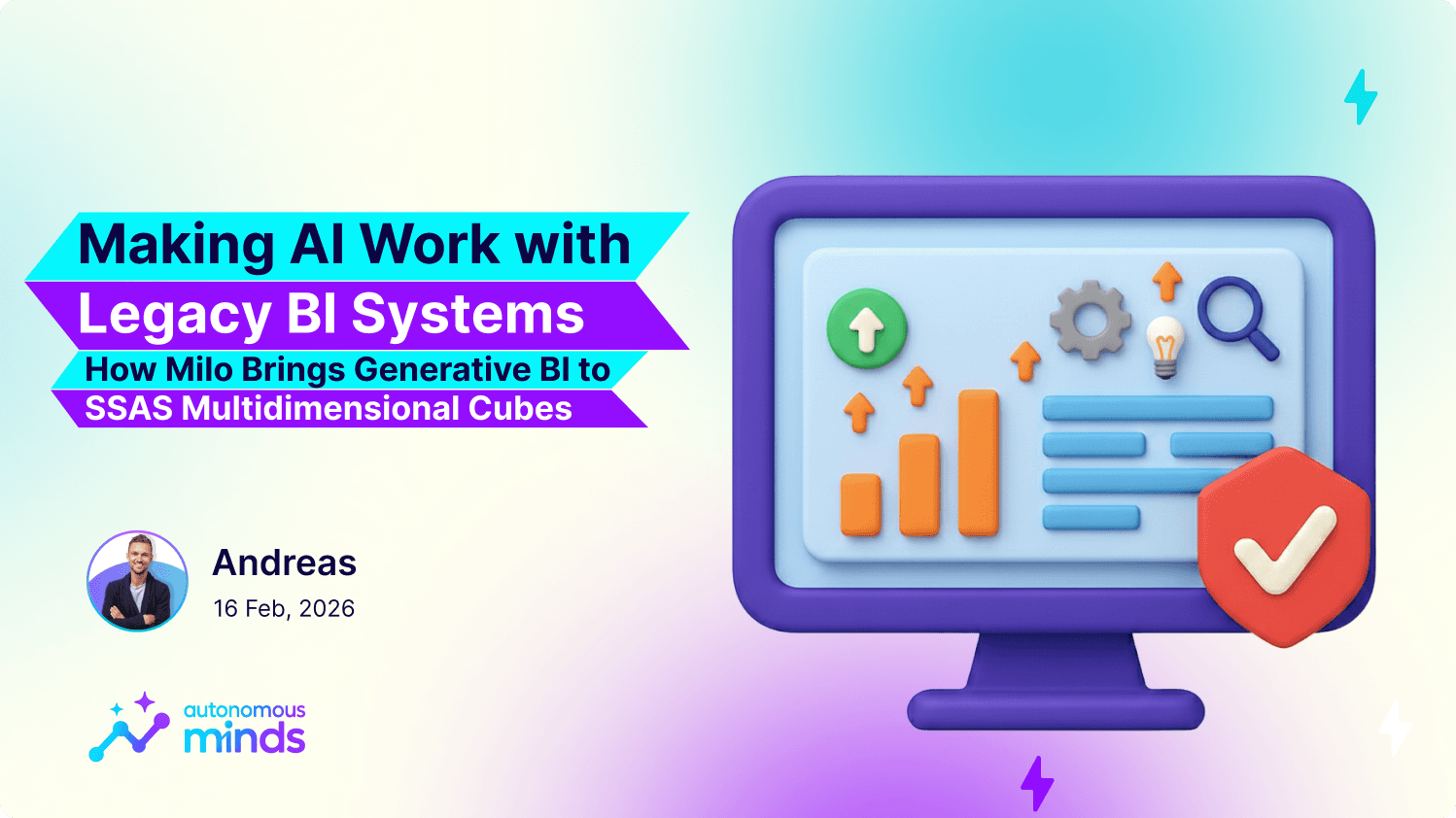
Making AI Work with Legacy Systems
Organizations with years of investment in Microsoft SQL Server Analysis Services (SSAS) multidimensional cubes face a difficult choice: abandon battle-tested infrastructure for modern analytics, or miss out on AI-powered decision-making. Autonomous Minds’ Milo proves there's a third option: extending Generative BI capabilities to legacy systems without requiring costly migration.

Andreas Koeberl
Co-Founder
The Challenge: Modern AI on Legacy Infrastructure
Why SSAS Cubes Still Matter
Despite the rise of modern analytics platforms, SSAS multidimensional cubes remain critical infrastructure for many enterprises. They excel at serving complex, highly aggregated analytics over massive historical datasets with many concurrent users. These systems provide:
Battle-tested semantic layers with rich hierarchies, KPIs, and calculated measures
Sophisticated security models enforced at the data layer
MDX calculations encoding years of business logic
Native integration with Excel and legacy reporting tools
The Migration Dilemma
Organizations cannot simply abandon these systems. Re-implementing intricate calculations and security rules in modern stacks is non-trivial and risky. Regulatory reporting requirements, tightly coupled downstream systems, and the sheer scale of business user adoption make "lift and shift" migrations expensive and disruptive.
For these companies, SSRS reports on top of SSAS cubes remain stable, paid-for platforms, even as they explore modern analytics capabilities in parallel.
Technical Obstacles
Connecting an AI agent to SSAS cubes presented three fundamental challenges:
Multi-Axis Data Structure
SSAS cubes return results across multiple axes, rows, columns, and slices, creating a fundamental shape mismatch with AI agents that expect flat, tabular data. The agent's reasoning model assumes traditional SQL-style result sets, not OLAP's dimensional structure.
Limited Connectivity Options
Native drivers for SSAS are either Windows-only (ADOMD.NET, OLE DB) or severely limited. The OPENQUERY approach suffers from an 8KB query size limit, produces only flattened results, and offers no parameterization—making it unsuitable for dynamic AI-generated queries.
Authentication Complexity
SSAS typically relies on Windows/Kerberos authentication, which creates significant friction from non-.NET environments, especially when navigating VPCs, network hops, and cloud-based agent infrastructure.
The Solution: XMLA Protocol and Intelligent Translation
Rather than forcing SSAS into a SQL paradigm, we embraced its native protocol and built a translation layer that bridges OLAP and AI reasoning.
Direct XMLA/HTTP Integration
SSAS exposes an XML for Analysis (XMLA) endpoint via msmdpump.dll that accepts MDX queries over SOAP and returns structured XML responses. By consuming this protocol directly, we bypassed the limitations of Windows-only drivers and SQL-based workarounds.
Bidirectional Translation Layer
We built an MDX generation engine that:
Translates the AI agent's tabular mental model (filters, groupings, aggregations) into valid MDX with appropriate axis mappings
Parses multi-dimensional XML responses from SSAS
Reshapes results into the flat, 2D tabular format the agent expects
This bidirectional translation lets Milo maintain its simple "ask questions, get answers" interface while leveraging the full power of multidimensional analytics underneath.
Simplified Authentication
We configured the SSAS XMLA endpoint with Basic authentication over HTTPS, eliminating the Kerberos double-hop problem. A simple service account allows our Go-based client to authenticate without Windows dependencies or complex delegation configurations.
Business Impact
This integration delivers immediate value to organizations with SSAS infrastructure:
Benefit | Impact |
Zero Migration Cost | Deploy Generative BI without rebuilding existing cubes or migrating business logic |
Preserve Investments | Leverage years of cube design, MDX calculations, and security models |
Gradual Modernization | Enable AI capabilities while running legacy and modern systems in parallel |
Reduced Risk | Avoid disrupting regulatory reporting and downstream systems |
Key Takeaways
Legacy doesn't mean obsolete: Well-designed legacy systems often contain irreplaceable business logic and proven scalability
Integration beats migration: Building bridges to existing infrastructure is often faster and safer than wholesale replacement
AI can adapt to data, not vice versa: Intelligent translation layers allow AI to work with data in its native format
Authentication matters: Simple, standards-based authentication removes significant integration friction
The Result: Milo's can now query complex SSAS cubes using natural language, delivering the benefits of Generative BI while preserving existing investments in cube design, security models, and business logic.
Conclusion
By meeting SSAS cubes on their own terms rather than forcing them into a SQL paradigm, Milo demonstrates that organizations don't have to choose between AI innovation and infrastructure stability. The right integration approach can deliver both.
For enterprises with significant SSAS investments, this means Generative BI isn't a distant future goal requiring years of migration, it's an immediate capability that respects and extends existing systems.
More insights to explore
Discover additional case studies, tips, and strategies to help your business grow and innovate faster.