2026
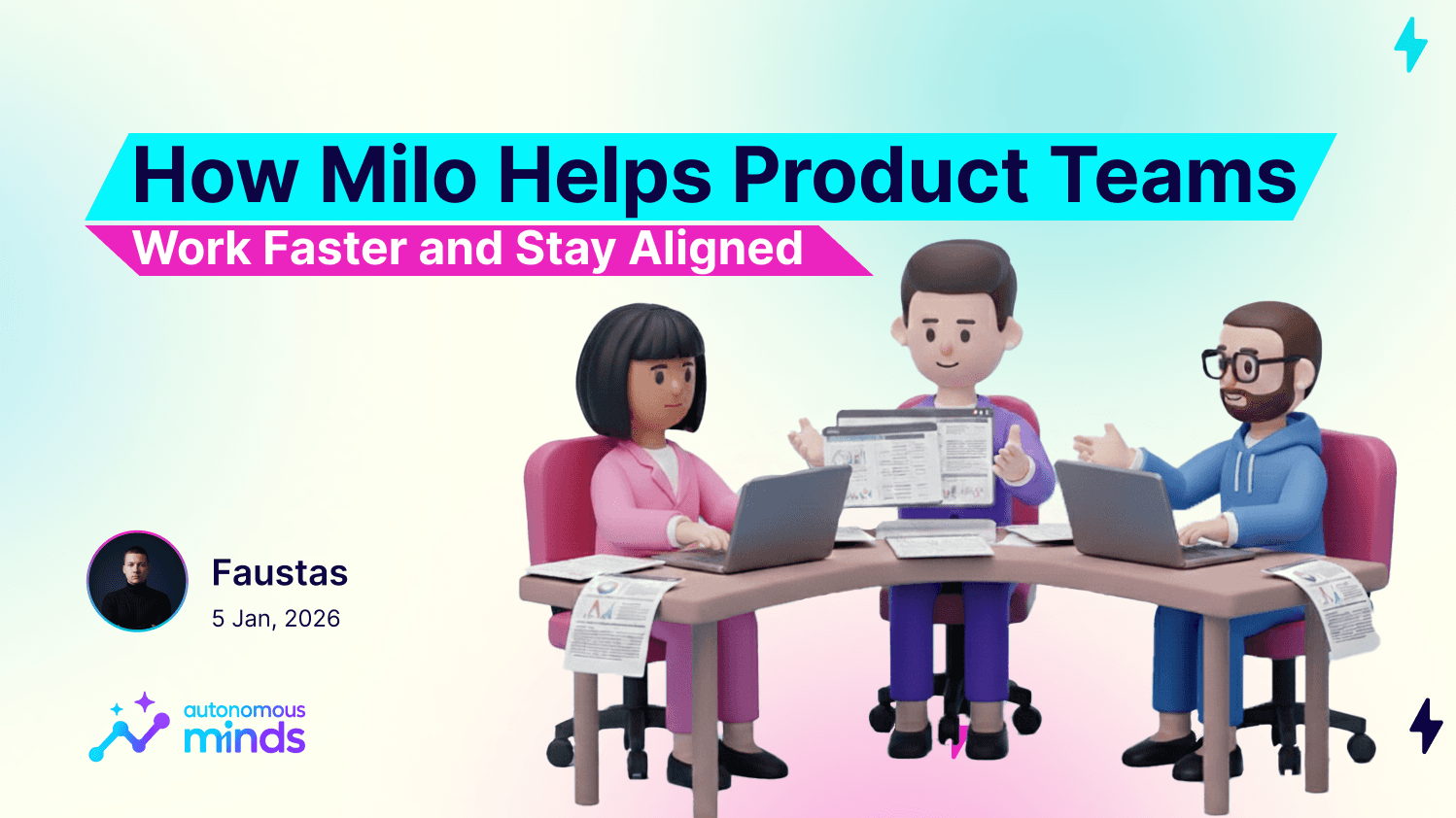
How Milo Helps Product Teams Work Faster and Stay Aligned
Product teams often choose between moving fast and staying aligned. But what if you didn't have to? Learn how instant data access helps teams make faster decisions without losing sync - and why alignment isn't overhead, it's leverage.

Faustas Rimkevičius
Founding Growth Marketer
The Core Tension
Product teams are expected to move fast and stay aligned. Ship features quickly. Keep everyone on the same page. Respond to feedback. Stay strategic.
But here's the thing: speed creates misalignment. When you're moving fast, people make decisions in silos, context gets lost, and teams drift out of sync. And alignment? That slows everything down. More meetings. More check-ins. More documentation that no one reads.
Most teams feel stuck choosing between the two. You can either move fast and deal with the chaos, or slow down to get everyone aligned and watch your velocity tank.
But it doesn't have to be a tradeoff.
Why Product Teams Slow Down as They Grow
When teams are small, staying aligned is almost automatic. Everyone's in the same room, hearing the same conversations, understanding the context behind every decision.
But as teams grow, something breaks.
Context gets scattered across Slack threads, Notion docs, Figma files, Jira tickets, and Google Drive. A designer updates a spec in one place. An engineer asks a question in another. A PM makes a decision in a meeting. No one knows where to look for the latest information, so they either make assumptions or interrupt each other constantly.
Decisions get made in meetings and then forgotten. Someone says, "Let's prioritize mobile," and everyone nods. Two weeks later, half the team is building desktop features because no one remembered the call, or wrote it down, or connected it to the work actually happening.
Rework becomes the norm. Engineers build something based on outdated requirements. Designers create flows that don't match what was discussed. PMs repeat context in every standup because people weren't in the original conversation. The team is working hard, but half the work is fixing what shouldn't have been built in the first place.
And stakeholders? They're all pulling in different directions. Sales wants this feature. Support says users need that. Leadership has a different vision. Without clear priorities and shared understanding, product teams spend more time managing expectations than building anything.
None of this is anyone's fault. It's just what happens when teams scale. But it's also why teams slow down.
What "Working Faster" Actually Means for Product Teams
When people talk about working faster, they often mean shipping more features or hitting more deadlines. But that's not real speed. That's just activity.
Real speed is about reducing friction. Fewer handoffs where context gets lost. Fewer clarification meetings where people ask, "Wait, why are we building this again?" Clear decisions that don't need to be re-litigated every sprint. Less rework because everyone understood the plan from the start.
Speed isn't about rushing. It's about clarity. When teams know what they're building and why, when they have the context they need without digging for it, when decisions don't have to be explained over and over - that's when they move fast.
The fastest teams aren't the ones cutting corners. They're the ones that don't have to redo work, don't have to backtrack on decisions, and don't waste time hunting for information.
What Alignment Really Looks Like (and Why It's Rare)
Here's what most people think alignment is: everyone reads the same document. Everyone attends the same meeting. Everyone nods in agreement.
But that's not alignment. That's just compliance.
Real alignment is shared understanding. It's when the PM, the designer, and the engineer all know not just what they're building, but why. When they can explain the reasoning behind a decision. When they understand how their work connects to the broader strategy.
It's knowing why a feature was prioritized over another. Why a certain design direction was chosen. What feedback influenced a decision and what was deliberately set aside. It's visibility - not just into what's happening, but into the thinking behind it.
This kind of alignment is rare because most tools aren't built for it. They're built to store information, not to connect it. You can document a decision, but if that decision lives in a doc no one reads, disconnected from the work itself, it might as well not exist.
The result? Teams confuse activity for alignment. Everyone's busy, everyone's updating their own corner of the system, but no one actually shares the same understanding of what's important or why.
How Milo Helps Product Teams Work Faster and Stay Aligned
This is where Milo comes in.
Milo is an AI data analyst that connects directly to your databases, data warehouses, and business tools. You ask questions in plain language, and Milo finds the answers across all your connected data sources - no SQL, no dashboards, no waiting for analysts.
But here's what makes Milo different for product teams: it's built for shared access from the ground up.
Milo operates as a multi-tenant system where everyone on the team - product, design, engineering, leadership can access the same information in natural language. When a PM asks, "How did user retention change after we launched that feature last week?" and gets an answer, that same conversation, data, and insights are visible to the entire team. No one's working from different versions of the data. No one's seeing filtered or interpreted results. Everyone sees the same unbiased, unopinionated information.
Teams can create shared dashboards that anyone can query in natural language. A designer can ask the dashboard, "Which user segments are struggling with this flow?" An engineer can ask, "What's the error rate for this feature by platform?" A PM can ask, "What's driving the drop-off in activation this week?" Everyone gets answers immediately, without needing to understand how the data is structured or where it lives.
And when action is needed, any team member with the right permissions can trigger it directly through Milo. Update a priority. Flag an issue. Adjust a workflow. The entire team can move from insight to action without handoffs, without waiting for someone else to make the change, without information getting lost in translation.
This is how alignment actually happens at speed. Not through more meetings or better documentation, but through shared access to the same real-time data, presented clearly, with everyone empowered to act on what they see.
Example: What This Looks Like in Practice
Here's what this looks like in practice.
Before Milo:
A product team is trying to decide whether to invest in improving the mobile onboarding flow. The PM has heard complaints from support, but needs data to make the case. They submit a ticket to the analytics team asking for mobile vs. desktop activation rates, drop-off points in the funnel, and cohort retention by platform.
Three days later, they get a dashboard. But it doesn't quite answer the question - it shows overall activation, not specifically onboarding. The PM sends a follow-up request clarifying what they need. Another two days pass. Meanwhile, the designer has different questions about which screens are causing problems. Engineering wants to know which user segments are most affected. Each question becomes another ticket, another wait, another email thread. By the time everyone has the answers they need individually, it's been two weeks, and the information is spread across five different reports that don't quite connect.
After Milo:
The PM asks Milo: "What's our mobile activation rate compared to desktop over the last 30 days?" The answer appears instantly, along with a breakdown showing mobile is underperforming by 18%. The PM shares this in a team channel.
The designer opens the same Milo workspace and asks: "Show me where mobile users are dropping off in the onboarding flow." Within seconds, they see that 42% of mobile users abandon at the account setup screen. They flag this directly in Milo for the team to see.
The engineering lead joins the workspace and asks: "Which user segments have the lowest mobile activation?" Milo shows that users on iOS 16 and below have significantly worse rates. The engineer triggers a priority flag on this issue directly through Milo - no Jira ticket needed, the whole team sees it immediately.
Meanwhile, a product leader checking in asks Milo the same initial question about mobile vs. desktop activation. They see the exact same data, the designer's findings, the engineering flag - all in one place. Everyone's looking at the same unbiased information. No one's working from an outdated report or a partial picture.
The team meets that afternoon, already aligned. They've all seen the data, asked their follow-up questions, and flagged what matters. The decision is obvious: prioritize the iOS account setup flow. They start building the next day. The entire discovery-to-decision process took three hours instead of two weeks.
Faster Because Aligned
The best product teams aren't choosing between speed and alignment. They've figured out that alignment isn't overhead - it's leverage.
When everyone can access the same data instantly, decisions get made faster. When teams don't have to wait days for reports or spend hours in meetings debating what the numbers say, they waste less time and move with more confidence. When insights are immediate and questions get answered in minutes instead of ticket queues, momentum doesn't stall.
The fastest teams aren't making wild guesses. They're making informed decisions quickly. They know what's working, what's not, and where to focus - not because they're brilliant, but because they have instant access to the data that shows them what's actually happening.
And as teams scale, that access becomes critical. More people, more questions, more decisions to make. Without instant data access, teams slow down - waiting, guessing, misaligning. With it, they accelerate - seeing the same insights, moving in the same direction, confident they're building the right things.
Tools like Milo exist to remove the friction between questions and answers. To make sure that as teams grow, as complexity increases, as the pace accelerates - data access doesn't become the bottleneck. Speed and alignment don't have to be a tradeoff. With the right tools, they reinforce each other.
If you're curious how teams approach this, you can explore Milo here.
More insights to explore
Discover additional case studies, tips, and strategies to help your business grow and innovate faster.