2025
Generative BI vs. Traditional BI vs. Text-to-SQL: What Actually Moves the Business
Traditional BI tells you what happened. Text-to-SQL makes asking easier—but often stops at a chart. Generative BI goes further: it explains why metrics moved and triggers the next step (safely), so teams get from what → why → done in minutes, not meetings.

Andreas Koeberl
Co-Founder
Traditional BI: powerful, but slow and siloed
Traditional BI tools (think Microsoft Power BI, Salesforce Tableau, Google Looker) are excellent at governed reporting, dashboards, static reports, and curated data models. The trade-off: they typically require a BI ticket, technical skills, or drag-and-drop expertise; most insights are historical and user-driven rather than proactive.
Where it shines: standardized KPIs, financial close, regulatory packs.
Where it struggles: urgent questions (“Why did UK GGR spike last night?”), multi-tool context (CRM + support + data warehouse), and closing the loop with actions.
Text-to-SQL: easier questions, same ceiling
Text-to-SQL translates a natural-language prompt into a query. It’s a helpful assist when data is clean and questions are straightforward. But it still depends on structured datasets, and the UX often ends at “here’s a chart.” For complex analysis, root causes, point-in-time comparisons, or multi-system joins, users revert to analysts or spreadsheets. In short: better entry point, limited follow-through.
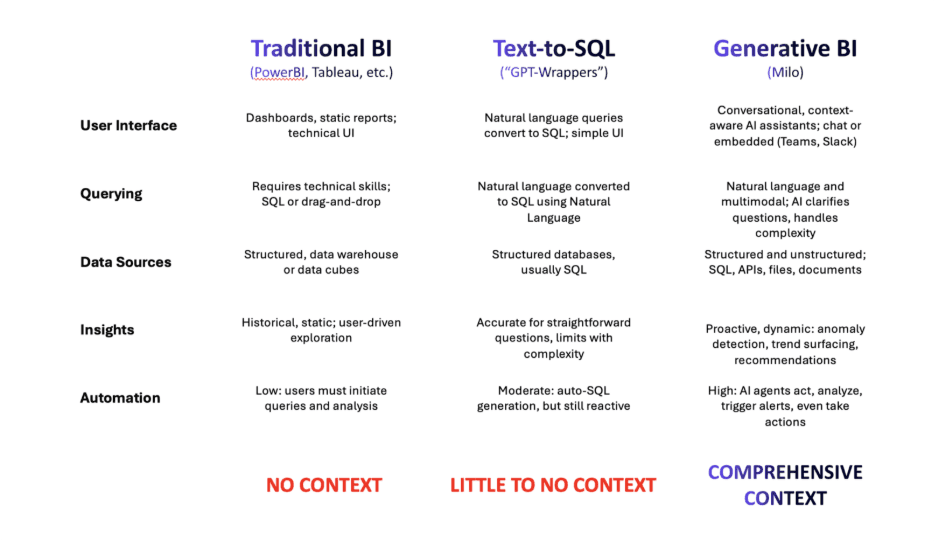
Quick compare (Traditional vs. Text-to-SQL)
UI: technical dashboards vs. simple Natural Language Query interfaces.
Insights: both are largely reactive; Text-to-SQL improves access, not outcomes.
Automation: low to moderate; actions usually remain manual.
Context: none to low
Generative BI: explain the “why”, then do what’s next
Generative BI reframes the job: don’t just visualize, contextualize and act. A GenBI system can handle structured and unstructured sources (Databases, tools, files, documents, etc.), reason about what changed, present a causal narrative with evidence, and then trigger governed actions (Slack summary or escalation, PDF report via email, CRM updates, scheduling meetings) with approvals and audit. Think of it as an agentic assistant embedded where teams work (chat, email, CRM), not another dashboard tab.
One example is Milo (Autonomous Minds): positioned as a Generative BI platform that “understands what’s going on in real time, explains why things moved and triggers the right action…without a data analyst”. The emphasis is on operational speed and follow-through rather than charts.
Side-by-side: what changes with Generative BI
A concrete example: from spike to “handled”
Question: “Explain yesterday’s revenue spike in the UK and brief our partner”.
Traditional BI: analyst pulls data, builds a chart; follow-ups happen via email and meetings.
Text-to-SQL: you ask in English and get a chart faster, but crafting the narrative and next steps is still manual.
Generative BI: Milo identifies drivers (e.g., hour/geo/device), checks related context (CRM campaign, support tickets), and then sends a Slack summary, generates a partner-ready PDF, and creates a CRM task, with approvals and audit, so someone owns the outcome.
Result: time-to-action shrinks from days to minutes, and every step leaves receipts.
How to start (this quarter)
Pick one painful KPI loop (e.g., revenue anomaly triage, churn-risk cohort, GGR spike handling).
Define “done”: the narrative you expect and the exact actions to trigger (Slack/PDF/CRM).
Set success SLAs: P95 time-to-insight ≤ 5 minutes, time-to-action ≤ 60 minutes.
Run a 2-week pilot: measure speed and adoption; require approvals & audit from day one.
Generative BI isn’t “chat over data.” It’s explainable operations: what happened, why it happened, and what got done, in one motion. When teams stop waiting on dashboards and start closing the loop, the business moves faster with more confidence.
More insights to explore
Discover additional case studies, tips, and strategies to help your business grow and innovate faster.