2026
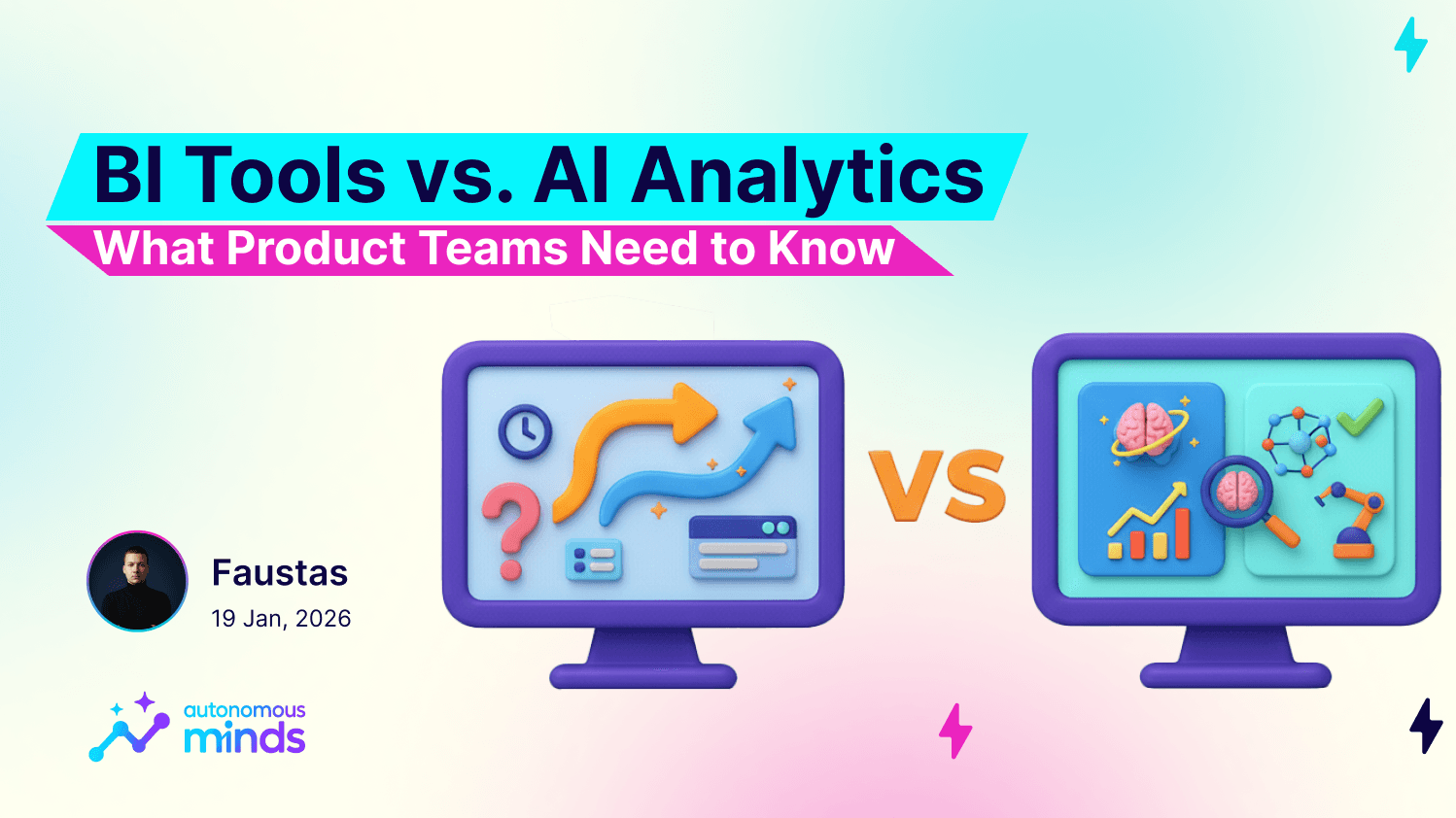
BI Tools vs. AI Analytics: What Product Teams Need to Know
Compare traditional BI tools with modern AI-powered analytics for product teams. Learn key differences, use cases, pros/cons, and how to choose the right approach to accelerate product decisions.

Faustas
Growth Marketing
Introduction
The analytics landscape for product teams has evolved dramatically. Where business intelligence (BI) tools once dominated the field with their dashboards and historical reports, AI-powered analytics platforms are now reshaping how product teams extract insights from data.
Business Intelligence (BI) tools are designed around structured reporting, data visualizations, dashboards, and historical performance analysis. They excel at answering "what happened" by organizing past data into digestible formats that help teams understand trends over time.
AI analytics, by contrast, pushes beyond descriptive insights into the realm of prediction, automation, and natural language interfaces. These platforms don't just tell you what happened - they help predict what will happen next, automatically surface anomalies, and allow anyone on your team to ask questions in plain English.
For product teams, this distinction matters enormously. The speed at which you can extract insights, the breadth of team members who can access data without technical barriers, and your ability to make proactive rather than reactive decisions all hinge on your analytics approach. As product cycles accelerate and competition intensifies, choosing the right analytics strategy isn't just a technical decision - it's a strategic imperative that directly impacts your ability to build better products faster.
What Are Traditional BI Tools?
Traditional business intelligence tools have been the backbone of enterprise analytics for decades. At their core, BI platforms transform raw data into structured reports, interactive dashboards, and scorecards that help organizations track key performance indicators and understand historical trends.
Core Functionality
BI tools typically offer:
Dashboard creation that visualizes metrics across customizable views
Reporting capabilities that generate scheduled or ad-hoc reports for stakeholders
Data modeling that connects multiple data sources into unified views
Scorecards and KPIs that track performance against targets
Drill-down functionality that lets users explore data hierarchies
Popular BI platforms include Microsoft Power BI, Tableau, Looker, and Qlik. These tools have become standard across industries, with enterprise adoption driven by their ability to consolidate data from multiple sources and present it through polished visualizations.
Strengths for Product Teams
For product organizations, traditional BI tools offer several advantages:
Historical performance tracking allows teams to monitor how features perform over time, measuring adoption curves, engagement metrics, and conversion funnels with precision.
Executive alignment becomes easier when leadership can access standardized dashboards that present product health metrics in familiar formats. Board meetings and quarterly business reviews rely heavily on these consistent reporting frameworks.
Cross-functional visibility ensures that marketing, sales, and customer success teams can all access the same product data, creating a shared understanding of performance.
Data governance features help maintain quality standards, ensure compliance, and control access to sensitive information across large organizations.
Limitations for Modern Product Work
Despite their strengths, BI tools present significant friction for fast-moving product teams:
Manual query requirements mean that most insights require writing SQL or using proprietary query languages. Product managers without technical backgrounds often hit walls quickly.
Technical gating creates bottlenecks. When every question requires a data analyst to build a new dashboard or modify a query, insight cycles stretch from minutes to days or weeks.
Slower insight cycles result from the inherent workflow: identify question → request dashboard → wait for analyst → review results → ask follow-up question → repeat. This cycle doesn't match the pace of modern product development.
Retrospective focus means BI tools excel at telling you what happened but offer limited capabilities for predicting what will happen or automatically identifying emerging patterns before they become obvious.
For product teams operating in competitive markets where speed matters, these limitations increasingly outweigh the benefits of traditional BI approaches.
What Is AI Analytics?
AI analytics represents a fundamental shift in how organizations interact with data. Rather than requiring users to define queries and build visualizations manually, AI-powered analytics platforms use machine learning models, natural language processing, and automation to surface insights proactively and answer questions conversationally.
Core Capabilities
Modern AI analytics platforms bring several transformative capabilities:
Machine learning models continuously analyze data patterns, learning what's normal for your product and automatically detecting anomalies, shifts, and emerging trends without manual configuration.
Natural language interfaces allow product managers to ask questions in plain English - "Why did sign-ups drop last week?" or "Which features correlate with retention?" - and receive instant, accurate answers without writing code.
Automated insight generation means the system proactively surfaces important patterns, anomalies, and opportunities without waiting for someone to ask the right question.
Predictive analytics goes beyond historical reporting to forecast future trends, estimate the impact of product changes, and help teams make proactive decisions.
Behavioral analysis examines user journeys, identifies segments automatically, and reveals patterns in how different cohorts interact with your product.
Accessibility Revolution
The democratization of data access represents one of AI analytics' most significant advantages. Product managers, designers, marketing managers, and customer success teams can all extract insights independently. The barrier to entry drops from "learn SQL" to "ask a question."
This accessibility doesn't just save time - it fundamentally changes how product decisions get made. Instead of quarterly reviews based on pre-built dashboards, teams can explore data continuously, following their curiosity and testing hypotheses in real-time.
AI Analytics Use Cases for Product Teams
AI analytics excels in several product-specific scenarios:
Behavioral prediction helps identify which users are likely to churn, convert to paid plans, or become power users before these outcomes occur, enabling proactive interventions.
Anomaly detection automatically flags unusual patterns in metrics - sudden drops in engagement, spikes in errors, or unexpected shifts in user behavior - often before they become visible in standard dashboards.
Trend forecasting provides data-driven projections of how metrics will evolve, helping teams anticipate capacity needs, set realistic goals, and identify growth opportunities early.
Impact analysis quantifies how product changes affect user behavior across multiple dimensions, making it easier to assess whether new features deliver intended outcomes.
Segment discovery automatically identifies meaningful user groups based on behavior patterns, revealing opportunities to personalize experiences or address unmet needs.
These capabilities transform analytics from a retrospective reporting function into a forward-looking strategic asset that actively guides product development.
Key Differences: BI vs AI Analytics
Understanding the practical distinctions between traditional BI and AI analytics helps clarify which approach fits different organizational needs.
Evaluation Criteria | BI Tools | AI Analytics |
|---|---|---|
Primary Goal | Descriptive Reporting | Predictive & Prescriptive Insights |
User Accessibility | Technical (SQL/DAX) | NLP & natural language queries |
Automation | Manual dashboard updates | Auto-generated insights/recommendations |
Time to Insight | Slow (dependent on analysts) | Near-instant real-time insights |
Predictive Capability | Limited | Built-in forecasting |
Product Focus | Metrics dashboards | Behavioral signals + future trends |
Primary Goal
BI tools answer "what happened?" through descriptive reporting. They excel at presenting historical data in organized formats but require users to interpret patterns and draw conclusions manually.
AI analytics answers "what will happen?" and "what should we do?" by combining historical patterns with predictive models and prescriptive recommendations. The system doesn't just show you data - it tells you what it means and suggests actions.
User Accessibility
BI platforms typically require technical proficiency. Building dashboards demands understanding of data structures, writing queries in SQL or proprietary languages like DAX, and knowing how to structure visualizations effectively. This creates a divide between those who can access insights (analysts, engineers) and those who need them (product managers, executives).
AI analytics removes technical barriers through natural language interfaces. Users ask questions conversationally and receive contextual answers. This democratization means everyone on the product team can explore data independently, dramatically reducing bottlenecks.
Automation Level
Traditional BI requires manual effort at every stage. Someone must build each dashboard, define every metric, and update reports when business logic changes. As your product evolves, maintaining BI infrastructure becomes increasingly resource-intensive.
AI analytics automates insight generation. The system monitors data continuously, surfaces anomalies automatically, and adapts to changes in your product without manual reconfiguration. Maintenance overhead drops while insight frequency increases.
Speed of Insights
BI tools create inherent delays. Product managers identify questions, submit requests to analysts, wait for dashboard creation, and often discover they need additional information, restarting the cycle. This workflow stretches insight cycles to days or weeks.
AI analytics delivers near-instant responses. Ask a question, get an answer immediately. This speed transforms how teams work, enabling rapid hypothesis testing and iterative exploration that matches the pace of modern product development.
Predictive Capabilities
BI platforms offer limited forecasting functionality. While some tools include basic trend lines or statistical projections, these features require manual configuration and often produce simplistic extrapolations.
AI analytics builds prediction into its core architecture. Machine learning models continuously refine forecasts based on new data, accounting for seasonality, trends, and complex interaction effects automatically. Product teams gain reliable projections without specialized data science expertise.
Product Focus
BI dashboards center on aggregate metrics - MAU, conversion rates, revenue. While valuable for executive reporting, these high-level views often obscure the behavioral nuances that drive product decisions.
AI analytics emphasizes behavioral signals and user-level patterns. Rather than just showing that engagement dropped, the system identifies which user segments drove the change, what behaviors shifted, and which product areas are affected. This granularity enables more targeted, effective product interventions.
Why Product Teams Should Care
The choice between BI and AI analytics isn't merely technical - it directly impacts product team velocity, decision quality, and competitive positioning.
Faster Decision Cycles
Speed matters in product development. Markets shift quickly, user expectations evolve continuously, and competitors move fast. Teams that can validate hypotheses, measure impact, and adjust course rapidly have a decisive advantage.
AI analytics compresses decision cycles from weeks to minutes. Instead of waiting for analyst support, product managers explore data directly, testing ideas and gathering evidence in real-time. This acceleration enables rapid iteration, where teams can ship changes, measure results, and adapt within single sprints rather than quarterly planning cycles.
Reduced Dependency on Data Backlogs
Every product organization has experienced this frustration: a critical question arises, a ticket goes to the analytics team, and the answer arrives weeks later - often after the decision has already been made based on intuition rather than data.
This bottleneck doesn't just slow teams down; it trains product managers to stop asking questions. Over time, organizations develop a culture where data-informed decisions become the exception rather than the rule, not because teams don't value data, but because accessing it is too cumbersome.
AI analytics eliminates these backlogs by empowering self-service exploration. Product managers find their own answers, analysts focus on strategic work rather than recurring requests, and the entire organization becomes more data-driven by default.
Empowering Product Managers
Traditional BI creates an artificial hierarchy where technical skill determines data access. Product managers with SQL proficiency can explore freely while those without must rely on intermediaries. This creates inequality in decision-making quality and often means the people closest to customers have the least direct access to behavioral data.
AI analytics levels this playing field. Product managers across experience levels and technical backgrounds can all extract insights independently. This democratization improves decision quality by ensuring those with the deepest product context can directly examine data without translation layers that introduce delays and information loss.
Bridging Cross-Functional Gaps
Modern product development requires tight collaboration between engineering, design, analytics, and product management. When only analysts can access data, these teams speak different languages and work from different information sets.
AI analytics creates a shared data language accessible to all disciplines. Engineers can verify their performance optimizations improved real user metrics. Designers can validate that interface changes drove intended behavioral shifts. Product managers can confirm feature adoption matches expectations. Everyone works from the same insights, reducing miscommunication and aligning efforts around shared understanding.
Proactive vs. Reactive Product Development
Perhaps most critically, AI analytics enables proactive product development. Traditional BI excels at post-mortem analysis - understanding what went wrong after it's already happened. AI analytics identifies emerging patterns early, predicts future outcomes, and flags anomalies before they escalate into crises.
This shift from reactive to proactive changes how product teams operate. Instead of fighting fires, teams prevent problems. Instead of measuring what happened, teams influence what will happen. This forward-looking approach compounds over time, creating increasing advantages for teams that adopt it early.
Common Misconceptions
As AI analytics gains traction, several myths have emerged that deserve clarification.
Misconception 1: AI Will Replace BI Entirely
The most common misconception positions AI and BI as competitors where one must win. Reality is more nuanced. AI analytics doesn't make BI obsolete - it complements and extends BI capabilities.
Traditional BI remains valuable for standardized reporting, governance-heavy use cases, and enterprise-wide metrics tracking. Many organizations will maintain BI infrastructure for executive dashboards, regulatory compliance reporting, and cross-functional scorecards.
AI analytics augments these capabilities by adding conversational access, predictive insights, and automated discovery. The two approaches coexist productively, with BI handling structured reporting and AI enabling exploratory analysis and predictive use cases.
Misconception 2: AI Eliminates the Need for Analysts
Some fear AI analytics will eliminate data analyst roles. The opposite typically occurs. AI removes repetitive dashboard maintenance and ad-hoc query work, freeing analysts to focus on higher-value activities.
Rather than building the same reports repeatedly, analysts can focus on:
Designing metrics frameworks that align with business strategy
Building advanced models that drive product personalization
Conducting deep-dive analyses that inform strategic decisions
Establishing data governance and quality standards
Training teams on effective data exploration techniques
AI analytics augments analyst capabilities rather than replacing them, similar to how calculators didn't eliminate mathematicians - they enabled them to tackle more complex problems.
Misconception 3: Dashboards Are Sufficient for Modern Product Insights
Many organizations assume that if they build comprehensive dashboards, they've solved their analytics needs. This "if we build it, they will understand" mentality overlooks fundamental limitations.
Dashboards show what you predicted would matter when you built them. They can't adapt to unexpected questions, follow-up inquiries, or evolving priorities. They represent one person's hypothesis about what's important, frozen at the moment of creation.
Modern product work requires exploration, not just reporting. Teams need to follow their curiosity, test hypotheses rapidly, and dig deeper when something seems anomalous. Static dashboards, no matter how well-designed, can't support this investigative workflow.
AI analytics enables the exploration dashboards promise but can't deliver. The question isn't whether you need dashboards—it's whether dashboards alone provide sufficient analytical capability for competitive product development.
Misconception 4: AI Analytics Requires Massive Data Teams
Some organizations assume AI analytics is only viable for companies with large data science teams. This misconception stems from confusing AI analytics platforms with custom AI development.
Modern AI analytics platforms are specifically designed for organizations without extensive data science resources. The AI is built into the platform - you don't need to train models, tune algorithms, or maintain infrastructure. Teams without a single data scientist can leverage sophisticated AI capabilities through intuitive interfaces.
This accessibility represents one of AI analytics' core value propositions: bringing advanced analytical capabilities to organizations of all sizes, not just tech giants with unlimited resources.
How to Choose the Right Approach
Selecting between BI, AI analytics, or a hybrid approach requires honest assessment of your team's needs, maturity, and constraints.
When Traditional BI Makes Sense
BI tools remain the right choice for several scenarios:
Regulatory and compliance reporting where standardized formats, audit trails, and governance controls are non-negotiable. Financial reporting, healthcare compliance, and regulated industries often require traditional BI capabilities.
Enterprise-wide standardization where hundreds or thousands of users need access to consistent, centralized dashboards. Large organizations with mature reporting structures may find BI's standardization valuable.
Historical deep-dives where analysts conduct complex investigations requiring custom data modeling and intricate transformations. Sophisticated BI platforms offer powerful data manipulation capabilities for these use cases.
Limited technical resources in organizations where adopting new platforms creates unsustainable overhead. If your team has already invested heavily in BI infrastructure and skills, wholesale replacement may not be justified.
When AI Analytics Shines
AI analytics provides maximum value in these contexts:
Fast-moving product teams where speed of insight directly impacts competitive positioning. Startups, growth-stage companies, and product organizations operating in dynamic markets benefit enormously from compressed decision cycles.
Self-service culture where empowering non-technical team members to explore data independently aligns with organizational values. Companies prioritizing autonomy and reducing bottlenecks find AI analytics transformative.
Predictive needs where understanding future trends, forecasting outcomes, and identifying emerging patterns drive strategic decisions. Product teams optimizing for retention, growth, and proactive intervention benefit from built-in forecasting.
Limited analyst resources where small teams are overwhelmed by recurring requests. AI analytics dramatically reduces analyst workload while improving insight accessibility across the organization.
Behavioral complexity where understanding user journeys, segment differences, and interaction patterns matters more than aggregate metrics. Products with nuanced user behavior benefit from AI's pattern recognition capabilities.
Building a Decision Framework
Choose your analytics approach based on these key factors:
Team size and composition: Smaller teams with limited analyst resources benefit more from AI analytics' self-service capabilities. Larger teams with established analyst functions may find hybrid approaches optimal.
Data maturity: Organizations with clean, well-structured data can leverage AI analytics immediately. Those still building data infrastructure might prioritize BI's governance features while working toward AI adoption.
Use case balance: If 80% of your needs involve standardized reporting, BI makes sense. If 80% involve exploration and prediction, AI analytics is better. Most organizations fall somewhere in between, suggesting hybrid approaches.
Technical resources: Consider not just current capabilities but future scalability. AI analytics reduces long-term dependency on scarce technical skills, while BI requires sustained analyst investment.
Budget constraints: Evaluate total cost of ownership including tool licensing, personnel costs, and opportunity costs of delayed insights. AI analytics often proves more cost-effective despite potentially higher upfront platform costs due to reduced personnel requirements.
The Hybrid Path
Many successful product organizations adopt hybrid strategies:
Maintain BI for executive dashboards, compliance reporting, and enterprise-wide metrics
Adopt AI analytics for product team exploration, predictive use cases, and self-service needs
Establish clear boundaries defining which questions each platform answers
Ensure data consistency so insights align across both platforms
This approach acknowledges that different stakeholders have different needs. Executives may prefer familiar dashboard formats, while product managers need conversational exploration. Rather than forcing everyone onto a single platform, hybrid strategies optimize for each use case.
Conclusion
The question isn't whether BI tools or AI analytics is "better" - it's which capabilities your product team needs to make faster, smarter decisions in an increasingly competitive landscape.
Traditional BI excels at standardized reporting, governance, and historical analysis. These capabilities remain valuable for enterprise organizations, regulated industries, and use cases requiring consistent, centralized dashboards.
AI analytics transforms how product teams work by compressing decision cycles, democratizing data access, and enabling predictive insights that help teams stay ahead of trends rather than react to them. For product organizations where speed, autonomy, and forward-looking analysis drive competitive advantage, AI analytics represents a fundamental capability upgrade.
The most successful approach for many organizations combines both: maintaining BI infrastructure for governance and executive reporting while adopting AI analytics for product team exploration and predictive use cases. This hybrid strategy acknowledges that different questions require different tools, and optimal analytics architecture serves diverse stakeholder needs.
As you evaluate your own analytics strategy, consider where your current approach creates friction, limits insight velocity, or gates access to critical data. The right analytics platform doesn't just present data more clearly - it fundamentally changes how your team works, enabling faster learning cycles, more confident decisions, and ultimately, better products that serve your customers more effectively.
Ready to Accelerate Your Product Insights?
Discover how Milo combines the best of AI-powered analytics with product team workflows. Get real-time insights, predictive analytics, and natural language queries that help your team make faster, data-driven decisions.
Explore Milo's AI Analytics Platform →
Looking for more guidance on modernizing your product analytics? Check out our resources:
Product Analytics Playbook: Best practices for building data-driven product cultures
AI Analytics ROI Calculator: Estimate time and cost savings for your team
Demo: See Milo in action with real product data
Transform how your product team works with data. Start your free trial today.
More insights to explore
Discover additional case studies, tips, and strategies to help your business grow and innovate faster.