2026
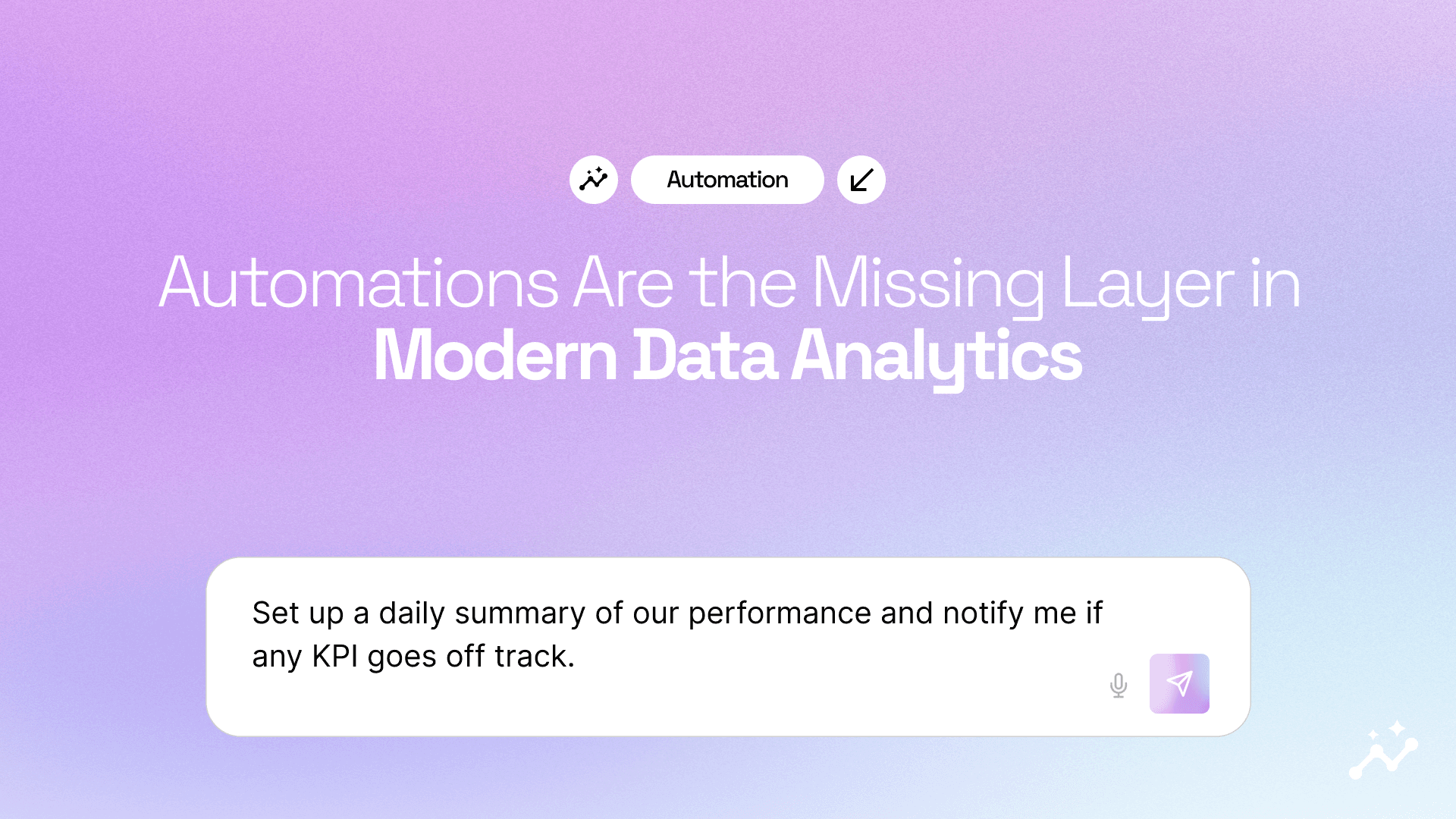
Automations Are the Missing Layer in Modern Data Analytics
Automations turn data analytics into real-time action. Learn how automated reports, alerts, and insights help teams move faster and make better decisions with Milo.

Faustas Rimkevičius
Growth Marketing
For years, businesses have invested heavily in dashboards, BI tools, and data teams. The promise was simple: better data leads to better decisions.
But in reality, most companies still struggle with a gap.
Not a data gap.
Not a tooling gap.
A time-to-action gap.
Data is there. Insights exist.
But action? That’s still manual.
This is where automations change everything.
The Evolution of Data Analytics
Traditional analytics workflows were never designed for the speed of modern business.
They look something like this:
Data gets collected
Someone builds a report
The report gets reviewed
Decisions are made (eventually)
The problem? This process is slow, repetitive, and reactive.
Even worse, analysts often spend more time preparing data than actually using it. Automation solves this by removing repetitive steps like report generation, and distribution - freeing teams to focus on insight and strategy.
Modern analytics is shifting toward something else entirely:
Always-on, real-time, and action-driven systems.
What Is Data Analytics Automation?
At its core, data analytics automation means using software and AI to:
Collect data
Process it
Generate insights
Deliver them automatically
Instead of manually building reports every week, systems can continuously analyze data and push insights where they’re needed.
This includes:
Scheduled reports (daily, weekly, monthly)
Real-time alerts when something changes
Automated summaries sent to Slack, email, or dashboards
Automation transforms analytics from a pull model (you go look for insights)
into a push model (insights come to you).
Why Automation Is Becoming Essential
Businesses today don’t just need insights - they need them fast, consistently, and at scale.
Automated analytics delivers exactly that:
1. Speed → From Hours to Seconds
Automated systems process data significantly faster than manual workflows, reducing time from question to insight .
2. Scale → Handle Growing Data Without Growing Teams
As data volume increases, manual analysis becomes unsustainable. Automation scales effortlessly across datasets and sources .
3. Accuracy → Less Human Error
Automation applies consistent logic, improving data quality and trust in insights .
4. Productivity → Focus on What Matters
Teams spend less time building reports and more time making decisions and solving real problems .
The Real Shift: From Insights to Action
Here’s the most important part:
Automation doesn’t just improve analytics - it operationalizes it.
Instead of:
Looking at dashboards
Spotting issues manually
Deciding what to do
You get:
Alerts when something changes
Reports delivered automatically
Signals that trigger action immediately
For example:
Revenue drops → instant alert to your team
Marketing campaign spikes → automated report sent daily
KPI threshold hit → Slack notification to decision-makers
This is the difference between knowing and acting in time.
Where Automations Deliver the Most Value
Not everything should be automated. But the highest-impact use cases are clear:
Repetitive Reporting
Weekly performance reports, marketing summaries, financial snapshots.
Monitoring & Alerts
Tracking anomalies, KPI changes, or operational issues in real time.
Cross-Team Visibility
Automatically distributing insights to stakeholders without manual effort.
Decision Loops
Creating systems where data continuously informs actions—without waiting.
Automation works best where tasks are:
Repetitive
Time-sensitive
Data-heavy
The Problem Most Companies Face
Interestingly, adoption isn’t the issue anymore.
Nearly 80% of UK businesses are already using AI tools - but only about 31% report clear ROI .
Why?
Because many companies:
Implement tools without clear workflows
Generate insights without distribution
Build dashboards that no one checks
Automation fixes this by connecting data → insight → delivery → action.
Automations in Milo
This is exactly the problem Milo is designed to solve.
With Milo automations, you can:
Set up reports to be delivered automatically (daily, weekly, monthly)
Create alerts based on your key metrics
Send insights directly to email or Slack
Customize what gets tracked and how it's delivered
No manual reporting. No chasing dashboards.
Just data that works for you - continuously.
The Future: Autonomous Decision Systems
We’re moving toward a world where analytics doesn’t just inform decisions - it drives them.
From:
Static dashboards
To:
Intelligent systems that monitor, analyze, and notify automatically
And eventually:
Systems that recommend - or even execute - actions in real time
Automation is the foundation of that future.
Final Thought
Data has never been more available.
But availability alone doesn’t create value.
Action does.
Automation is what turns analytics into action -
and action into outcomes.
If you’re already using Milo, start with a simple automation:
One report
One alert
One key metric
Then build from there.
Because the real power of analytics isn’t in seeing the data.
It’s in what happens next.
More insights to explore
Discover additional case studies, tips, and strategies to help your business grow and innovate faster.